
About
About Southeast University
Southeast University (东南大学) traces its origins to Sanjiang Normal College, founded in 1902 on the site of the Ming Dynasty’s Imperial College in Nanjing. The school became Liangjiang Normal College in 1905 and Nanjing Higher Normal School in 1915, and was rebuilt as National Southeast University in 1921. In 1928 it was reorganised as National Central University. In the 1952 national restructuring, Nanjing Institute of Technology was established on the Sipailou campus, and in May 1988 it took back the name Southeast University. In 2000 SEU merged with Nanjing Railway Medical College and Nanjing Transportation College, and Nanjing Geological School was incorporated.
SEU’s main campuses are Sipailou, Jiulonghu and Dingjiaqiao, covering 5,888 mu in total; Jiulonghu, in Jiangning District, accounts for 3,752.35 mu. SEU also has campuses in Wuxi, Suzhou and Nantong. Two campuses matter most for international students. Jiulonghu has the College of International Students (Lanyuan Building 3) and the Lanyuan dormitory. Dingjiaqiao, the medical campus, has the second international dormitory.
SEU is a national key university directly under the Ministry of Education and co-built with Jiangsu Province. It was part of Project 985 and Project 211, and in 2017 it was placed on the Class A list of universities to be built into world-class institutions. Twelve of its disciplines are on the second-round Double First-Class list. The university introduction (updated 26 March 2026) counts 39 schools and departments, 85 undergraduate majors and 43,651 full-time students: 17,277 undergraduates and 26,256 graduate students. It also counts 2,381 international students, 1,688 of them degree students, along with 3,070 full-time teachers and 19 academicians. Other official pages give different international-student counts: 2,165 on the English General Information page (March 2025) and 2,005 on the English homepage. This guide uses 2,381, which is also the College of International Students’ own count as of 31 December 2025.
QS lists SEU at #=335 in the 2027 edition and #=428 in 2025
Mechanical engineering; materials; electronic science; information and communication engineering; control; computer science; architecture; civil engineering; transportation engineering; biomedical engineering; landscape architecture; art theory
Engineering 13th and computer science 5th worldwide (university introduction, March 2026)
Roots back to 1902
SEU’s predecessors include Sanjiang Normal College, National Southeast University, National Central University and Nanjing Institute of Technology; the university took back the Southeast University name in 1988.
Engineering and architecture at the core
Architecture, civil engineering, transportation engineering and landscape architecture sit on the Double First-Class list alongside electronics, communications, computing and biomedical engineering.
A study-in-China demonstration base
According to the College of International Students (established in December 2005), SEU was in the Ministry of Education’s first batch of demonstration-base universities for international students in 2014.
English-taught MBBS since 2006
The Medical School’s six-year English-taught MBBS reports more than 1,000 graduates.
Admission
Admission, programs & tuition
All international applications go through the College of International Students (海外教育学院) at fs.seu.edu.cn. You may choose only one program, and repeat applications are disqualified. Once your file passes the initial review, the system asks for the application fee, which is non-refundable “whether you are admitted or not”. Final results appear on the College website around July. On 25 November 2025 the College published separate 2026 undergraduate and postgraduate guides, alongside program guides for the English-taught Clinical Medicine program (MBBS), E-commerce, Tourism Management, the School of Architecture and three YES-CHINA master’s programs. All of them are embedded documents whose full text this guide could not read. The figures below therefore come from four other sources: the College’s standing fee pages, its 2026 scholarship pages (which give the 2026 application window and document list), the Medical School and School of Architecture admission pages, and the 2025 undergraduate guide where stated. No 2027 guide had been published by mid-September 2026. The pages consulted give no upper age limit for any level. The School of Architecture requires a China Scholastic Competency Assessment (CSCA) mathematics transcript for its English-taught Bachelor of Architecture; whether other undergraduate majors need the CSCA could not be confirmed.
Degree programs
Select a degree level to see tuition, duration and entry requirements.
Bachelor’s degreeUndergraduate
Chinese-taught bachelor’s degrees across SEU’s schools; the 2025 guide lists more than 60 majors in 28 schools. The only English-taught options are Clinical Medicine (the MBBS, below) and the School of Architecture’s Bachelor of Architecture (English). The College also issued separate 2026 guides for E-commerce and Tourism Management.
- Chinese-taught: arts
- RMB 16,000 / year
- Chinese-taught: engineering
- RMB 19,000 / year
- Chinese-taught: medicine
- RMB 20,000 / year
Application requirements
- Non-Chinese citizen over the age of 18 who has graduated from high school, with a passport valid for more than one year.
- Chinese-taught programs: HSK 4 or above with a score of 200 or more.
- English-taught programs: TOEFL 80, IELTS 6.0 or Duolingo 100 if English is not your first language.
- High-school diploma and transcripts; SAT, IB, GCE A-Level or ACT results are also accepted.
- Bachelor of Architecture (English): a CSCA transcript with mathematics as the compulsory subject, and a portfolio of up to 20 pages (under 20 MB). A portfolio is also required for Architecture, Urban Planning and Landscape Architecture.
- Non-criminal record certificate and a notarized Foreigner Physical Examination Form from the last six months.
MBBS (Clinical Medicine, English-taught)Undergraduate
The Medical School’s six-year English-taught medical degree, offered since 2006, with case-based seminars and practical training at the National Experimental Teaching Demonstration Center for Basic Medical Sciences and the Clinical Skills Training Simulation Hospital.
- English-taught MBBS
- RMB 32,000 / year
Application requirements
- Healthy non-Chinese citizen over 18, with a high-school diploma or above and a valid passport.
- TOEFL 80 or IELTS 6.0 if your mother tongue is not English.
- The Medical School page gives a recurring application window of 15 November to 30 June, with no year stated; confirm the dates in the 2026 Clinical Medicine guide.
Master’s degreeGraduate
Chinese-taught master’s programs across the university, plus English-taught programs. The English-taught list includes three YES-CHINA scholarship programs: Belt and Road Digital and Intelligent Management, Belt and Road Sustainable Infrastructure, and Public Health in Global Health. It also covers electronic and communication engineering, power engineering, transportation engineering, translation and interpreting, electronic science, civil engineering, electrical engineering, biology and international business. The SEU–Monash Joint Graduate School in Suzhou awards degrees from both universities.
- Chinese-taught: arts / engineering / medicine
- RMB 18,000 / 23,000 / 30,000 per year
- English-taught: arts
- RMB 30,000 / year
- English-taught: engineering
- RMB 33,000 / year
- English-taught: medicine
- RMB 35,000 / year
Application requirements
- Bachelor’s degree and a passport valid for more than one year.
- Chinese-taught programs: HSK 4 (200+); HSK 5 or above for medicine, humanities, and economics and management.
- English-taught programs: TOEFL 80 or IELTS 6.0; the Chinese-language 2026 page also accepts Duolingo 100.
- Two recommendation letters and a research proposal of at least 800 words; a supervisor acceptance letter is required at certain schools.
- HSK at graduation: level 5 for Chinese-taught master’s students. For English-taught master’s students the Chinese-language page requires level 3, but the English SEU Scholarship page prints level 8 — confirm with the College.
Doctoral degreeGraduate
Supervisor-led doctoral study in Chinese or English. Every applicant needs a supervisor acceptance letter; the College suggests finding supervisors through the faculty (师资队伍) pages of each school’s website.
- Chinese-taught: arts / engineering / medicine
- RMB 28,000 / 33,000 / 50,000 per year
- English-taught: arts
- RMB 33,000 / year
- English-taught: engineering
- RMB 38,000 / year
- English-taught: medicine
- RMB 55,000 / year
Application requirements
- Master’s degree and a passport valid for more than one year.
- A supervisor acceptance letter (mandatory).
- HSK 4 (200+), or HSK 5 in medicine, humanities, and economics and management, for Chinese-taught programs; TOEFL 80, IELTS 6.0 or Duolingo 100 for English-taught programs.
- Two recommendation letters and a research proposal of at least 800 words. Architecture applicants also submit a portfolio or writing sample (up to 30 pages) and a personal statement of about 1,000 words.
Non-degree programs
Chinese Language Program
Taught by the Chinese Language Center, whose courses run from short-term and practical Chinese through basic, elementary, intermediate and advanced levels to subject-specific Chinese. It also offers HSK preparation and culture courses in calligraphy, painting, opera, sculpture and the Chinese economy. The 2026 program guide, published 10 March 2026, is an embedded document; this guide could not read its dates.
Fee · RMB 16,000 / year
General / senior advanced (visiting) study
Non-degree study within a school. The general track is for undergraduate and master’s-level students, the senior track for PhD-level students.
Fee · RMB 16,000 / year (general) · RMB 20,000 / year (senior)
Exchange Program
For students nominated by an SEU partner university, who then apply at fs.seu.edu.cn. Submit transcripts, a passport scan and a letter from your home university’s international office; full-year students also need a physical examination record. Nomination deadlines: 31 December for spring entry, 15 June for autumn.
Fee · Not stated on the exchange guide
International Foundation (Pre-university) Program
The College published a guide to this program on 10 March 2026 as an embedded document; this guide could not read its duration, fees or progression rules. Ask admission@seu.edu.cn.
Fee · Not stated on readable pages
Short-term group programs
Group programs organised with partner institutions.
Fee · RMB 1,600 for 2 weeks + RMB 650 per person per extra week (materials extra)
Documents to prepare
- Passport valid for more than one year.
- Highest degree certificate (original or notarized), or a pre-graduation certificate, using the College’s expected-graduation form.
- Transcripts from high school onward.
- Language certificate: HSK for Chinese-taught programs; TOEFL, IELTS or Duolingo for English-taught programs.
- Graduate applicants: two recommendation letters, a research proposal of 800 words or more and, where required, a supervisor acceptance letter on the College’s template.
- Foreigner Physical Examination Form from the last six months, issued by a hospital and officially notarized.
- Certificate of no criminal record and the International Student Financial Support Guarantee Statement.
- Portfolio (architecture and planning majors); CSCA mathematics transcript (English-taught Bachelor of Architecture).
- Documents must be in Chinese or English, or come with a notarized translation.
Application timeline
These are the dates Southeast University published for the 2026 intake. That cycle has closed. Use them as a guide to when each step falls in the year, and check the official pages for the 2027 dates before you plan around them.
- 1
2026 postgraduate window opens
22 Nov 2025Date given on the SEU Scholarship and CSC postgraduate pages.
- 2
2026 undergraduate and postgraduate guides published
25 Nov 2025The undergraduate application windows are in the 2026 undergraduate guide.
- 3
CSC High-level Graduate Program deadline
By 28 Feb 2026Silk Road Program dates were listed as “to be announced”.
- 4
CSC High-level Postgraduate admission list
12 May 2026 - 5
SEU Scholarship deadline
By 15 May 2026 - 6
Autumn exchange nominations
By 15 Jun 2026The MBBS window on the Medical School page closes 30 June.
- 7
Accommodation reservation notice
26 Jun 2026Covers on-campus room reservation and fee payment for 2026–27.
- 8
Results and fee notices
Jul 2026Final results are posted around July; the Silk Road admission list appeared on 7 July and the tuition and accommodation payment notice on 9 July.
- 9
Arrival and registration
Late Aug – Sep 2026The College posted its arrival guide on 25 August; SEU’s opening ceremony is set for 17 September 2026.
Tuition depends on level, discipline group (arts, engineering or medicine) and teaching language. Chinese-taught tuition is RMB 16,000–20,000 a year for a bachelor’s degree, 18,000–30,000 for a master’s and 28,000–50,000 for a doctorate. English-taught tuition is RMB 32,000 for the MBBS, 30,000–35,000 for a master’s and 33,000–55,000 for a doctorate. The fee table carries no year label, and this guide found no official tuition figure for the English-taught Bachelor of Architecture. On top of tuition, budget RMB 800 a year for insurance and RMB 9,000 a year for a shared double room, plus utilities (the 2025 guide quoted RMB 6,000–9,000 for the room). The official pages disagree on the application fee: RMB 400 in the 2025 guide, RMB 800 on the Expenses and Medical School pages. Either way it is non-refundable. Non-degree study costs RMB 16,000–20,000 a year.
Funding
Scholarships
The College’s scholarship table lists six schemes. The Chinese Government Scholarship (CSC), the Jiangsu Provincial Government/Jasmine Scholarship and the Nanjing Municipal Government Scholarship are open to postgraduates, undergraduates and non-degree students. CSC’s postgraduate track is for postgraduates only, the SEU President Scholarship is for degree students only, and the International Chinese Language Teachers Scholarship is for language students only. The College says awards range “from the full scholarship covering all tuition fees and RMB3500/USD556 monthly allowance to the partial scholarship with the waiver of some tuition fees”. Applicants who pass all reviews are considered for CSC and President awards on an overall assessment, and CSC awards also need an application in the CSC online system. Anyone who wins an award and then gives up the admission cannot apply for it again, and SEU Scholarship holders face an annual review (the 2025/2026 review notice was issued on 21 April 2026).
Chinese Government Scholarship — Bilateral Program (Type A)
According to the College, a Chinese Government Scholarship covers tuition and accommodation and pays a living allowance. The China Scholarship Council sets the full terms.
Eligibility: Apply through the Chinese embassy in your home country. The 2025 undergraduate guide lists Type A as an option for undergraduates.
Chinese Government Scholarship — High-level Graduate Program (Type B)
Chinese Government Scholarship terms. Full CSC scholarship holders who rent off campus can apply for a housing subsidy (amount not published).
Eligibility: Master’s and doctoral applicants; the 2026 window ran 22 November 2025 – 28 February 2026. In the SEU system, choose “Chinese Government Scholarship (Type B)”, then apply on the CSC system under agency number 10286, program type B. The 2026/2027 admission list came out on 12 May 2026.
Chinese Government Scholarship — Silk Road Program
Chinese Government Scholarship terms.
Eligibility: Postgraduate applicants. The 2026 dates were listed as “to be announced”; the 2026/2027 admission list came out on 7 July 2026.
Chinese Government Scholarship — YES-CHINA Excellence master’s programs
Chinese Government Scholarship funding attached to three English-taught master’s programs.
Eligibility: Applicants to Belt and Road Digital and Intelligent Management, Belt and Road Sustainable Infrastructure, or Public Health in Global Health. The guides for these programs are embedded documents this guide could not read, so check them for deadlines.
Jiangsu Provincial Government / Jasmine Scholarship
SEU does not publish coverage amounts for this scholarship.
Eligibility: SEU’s scholarship table marks it as open to postgraduates, undergraduates and non-degree students. The College’s former Chinese-language Jasmine page is gone, and the current Chinese scholarship menu no longer lists the award, so ask admission@seu.edu.cn whether SEU is nominating candidates for your intake.
Nanjing Municipal Government Scholarship
SEU does not publish the amount.
Eligibility: Open to all three student groups; the application form is available to download. The College’s latest notice (2024) restricts it to continuing students within their standard study period and sets minimums: GPA 2.3 for Chinese-taught undergraduates, a standardized score of 75 for graduate students, and a class ranking for MBBS students. Holders of full CSC, full provincial or SEU scholarships are excluded.
SEU Scholarship (SEU President Scholarship)
SEU’s own award, somewhere in the College’s stated range: from full tuition plus RMB 3,500 (USD 556) a month down to a partial tuition waiver.
Eligibility: Degree students only. The 2026 window ran 22 November 2025 – 15 May 2026 through fs.seu.edu.cn, with one program per applicant, the full document set, and a supervisor letter for doctoral and some master’s programs.
International Chinese Language Teachers Scholarship
The scholarship scheme sets the terms.
Eligibility: Non-degree Chinese language students only.
Research
Research at the university
SEU’s research strengths match its Double First-Class list: architecture and landscape; civil and transportation engineering; electronics, communications, control and computing; materials and mechanical engineering; and biomedical engineering. The university introduction (March 2026) says SEU leads 3 national key laboratories and co-builds 5 more, leads 1 national technology innovation centre and co-builds 2, and leads 1 national engineering research centre and 2 national engineering technology research centres. The English General Information page (March 2025) gives an older reading: 8 national key laboratories and 3 national technology innovation centres, whose totals match the led and co-built facilities combined.
Architecture & landscape
Both are Double First-Class disciplines. The School of Architecture runs its own English-taught admissions and joint programs such as the SEU–KTH Summer School.
Civil & transportation engineering
Both are Double First-Class disciplines. SEU’s English Overview page cites its work on the Hong Kong–Zhuhai–Macao Bridge.
Electronics, communications & computing
Electronic science, information and communication engineering, control and computer science are all on the list. SEU is a founding member of the Alliance of Key Laboratories in the Field of Communications (2024).
Biomedical engineering & medicine
Biomedical engineering is a Double First-Class discipline; the Medical School runs the English-taught MBBS.
- 3,698 invention patent applications and 2,472 grants in 2025; by year-end SEU held 18,357 valid invention patents, eighth among Chinese universities.
- In ESI, engineering ranks 13th and computer science 5th worldwide.
- Mechanical engineering was newly added to SEU’s disciplines in the second Double First-Class round.
- A 67,700 m² library holding 4.942 million print volumes.
Global engagement
Global engagement
SEU’s International Cooperation Office counts more than 160 partner universities and research institutions in over 45 countries and regions. By region: Europe 83, Asia 42, the Americas 28, Oceania 11 and Africa 3. The Chinese university introduction uses a narrower measure: close partnerships with more than 60 institutions in 20 countries or regions. For international students, the most visible partnership is the SEU–Monash Joint Graduate School in Suzhou.
SEU–Monash University Joint Graduate School (Suzhou)
Approved by the Ministry of Education in 2012 and based in Suzhou Industrial Park. It runs two-year English-taught master’s programs in industrial design engineering, computer technology, transportation engineering, international business and translation, and graduates receive degrees from both SEU and Monash.
Founding member of international alliances
SEU is a founding member of three alliances: the UK China University Consortium on Engineering Education and Research (2017), the World Alliance of Universities on Carbon Neutrality (2021) and the Alliance of Key Laboratories in the Field of Communications (2024).
Regional consortia
It is also a member of the Sino-European Engineering Education Platform, the Association of Sino-Russian Technical Universities, the Jiangsu–UK 20+20 World-class University Consortium and the Sino-Australia Engineering Universities Consortium.
Industry-funded master’s cohort
The School of Transportation runs a CRBC–Southeast University master’s program for Pakistani graduate students, fully funded by China Road and Bridge Corporation.
Career
Career & alumni
SEU does not publish employment or salary outcomes for its international graduates. The College of International Students’ Student Employment page (学生就业) posts recruitment notices aimed at international students; at the time of checking it listed 28, including 2026 postings from engineering firms such as PowerChina Municipal Construction Group. Before you take any job, note the College’s rule: without permission from the International Student Center and the exit-entry authorities, international students may not work or intern in China in any form.
Career support
- Student Employment page with recruitment and internship notices for international students.
- Work-study and internship approval through the International Student Center (+86-25-83792797).
- Academic exchange events for international graduate students, such as the 2026 “Experience China” Yangtze River Delta event.
Notable alumni
Chien-Shiung Wu
Experimental physicist
Huang Weilu
Missile engineer, recipient of the Two Bombs, One Satellite Merit Medal
Xia Peisu
Computer scientist
Harry Shum
Computer scientist and former Microsoft executive vice president
Yung Ho Chang
Architect and MIT professor
Campus life
Campus life
International students live in double rooms. Each has its own bathroom, a water heater and shower, air-conditioning, single beds, desks, chairs and wardrobes. The College’s dormitory page says rooms are scarce and allocated first come, first served, with no advance booking. For 2026–27, however, the College issued a room reservation and fee-payment notice on 26 June 2026, so follow the instructions sent after admission. Accommodation costs RMB 9,000 per academic year. Students staying a year or longer pay the full year up front, and utilities are paid separately. If you live off campus, you must register with the police within 24 hours of moving in, with your landlord’s help, and file a form with the International Student Center.
Accommodation
Lanyuan — Jiulonghu Campus
RMB 9,000 / academic year
Jiangning District, same campus as the College of International Students. Dormitory managers: +86-15312090060. Utilities extra.
Qiu’en No. 6 — Dingjiaqiao Campus
RMB 9,000 / academic year
87 Dingjiaqiao, on the medical campus. Dormitory manager: +86-25-83272372. Utilities extra.
Off-campus housing
Market rent
Full CSC scholarship holders who rent off campus can apply for a housing subsidy with their lease; the amount is not published.
Dining
The College does not publish canteen locations or meal prices for international students, so budget for food separately.
Facilities
Library
67,700 m² holding 4.942 million print volumes.
Chinese Language Center
Chinese and culture courses plus HSK training for international students across SEU.
Health insurance
Self-funded, visiting, language and exchange students, and those whose scholarship has ended, buy their own medical insurance before registration and the visa application. It costs RMB 800 a year according to the Expenses page. Inpatient prepayment is available on 4008105119, and policy details are at www.lxbx.net.
Visa & residence permit
All students must hold a study visa and a study residence permit; the College warns that violations can bring fines, warnings or deportation.
Campus
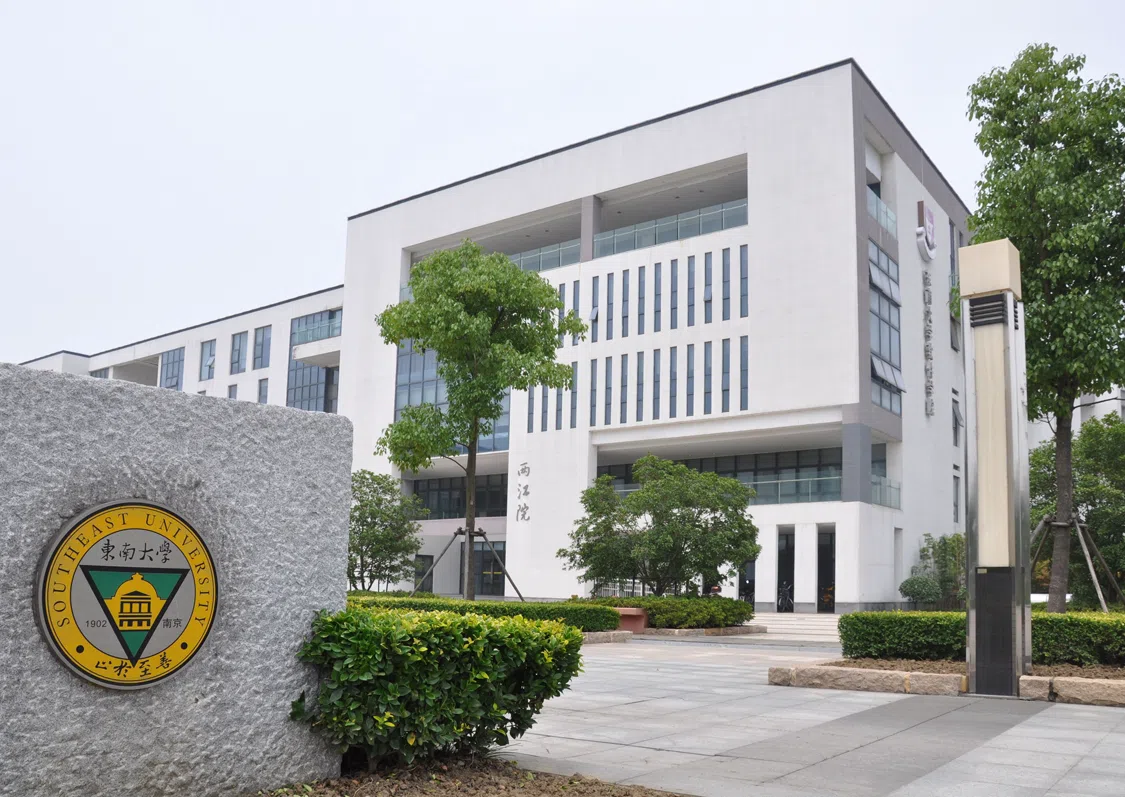
Southeast University in photos
FAQ
Frequently asked questions
How much is tuition at Southeast University for international students?+
Chinese-taught bachelor’s programs cost RMB 16,000 a year in arts, RMB 19,000 in engineering and RMB 20,000 in medicine; the English-taught MBBS costs RMB 32,000. Master’s programs cost RMB 18,000–30,000 in Chinese and RMB 30,000–35,000 in English. Doctoral programs cost RMB 28,000–50,000 in Chinese and RMB 33,000–55,000 in English. Add RMB 800 a year for insurance and RMB 9,000 for a double room. The application fee is RMB 400 in the 2025 guide but RMB 800 on the Expenses and Medical School pages.
What HSK or English level do I need?+
Chinese-taught programs need HSK 4 with 200 points or more; graduate programs in medicine, humanities, and economics and management need HSK 5. English-taught programs need TOEFL 80, IELTS 6.0 or Duolingo 100. Chinese-taught master’s students must also reach HSK 5 before graduating. For English-taught master’s students, the Chinese page says HSK 3 but the English page says HSK 8, so confirm with the College.
What are the 2026 application deadlines?+
The postgraduate window opened on 22 November 2025. The CSC High-level Graduate Program closed on 28 February 2026 and the SEU Scholarship on 15 May 2026. The Medical School’s MBBS window runs from 15 November to 30 June. Undergraduate batch dates are in the 2026 undergraduate guide. Exchange nominations close on 15 June for autumn entry. Results come out around July. No 2027 guide had been published by September 2026.
Does Southeast University offer the Jiangsu Jasmine Scholarship?+
SEU’s scholarship table lists the Jiangsu Provincial Government/Jasmine Scholarship for all student groups. However, SEU publishes no amounts or dates for it, and its dedicated page is gone, so ask admission@seu.edu.cn. The table also lists Chinese Government Scholarship tracks, the Nanjing Municipal Government Scholarship, the SEU President Scholarship and the International Chinese Language Teachers Scholarship.
Is there an age limit?+
Undergraduate and MBBS applicants must be over 18. None of the College pages consulted gives an upper age limit at any level.
Do I need the CSCA test?+
Yes for the English-taught Bachelor of Architecture, which requires a CSCA mathematics transcript. For other undergraduate majors, check the 2026 undergraduate guide. The postgraduate pages consulted do not mention the CSCA.
Where will I live?+
In a double room with its own bathroom, either at Lanyuan on the Jiulonghu Campus or at Qiu’en No. 6 on the Dingjiaqiao Campus. Rooms cost RMB 9,000 a year plus utilities. Follow the College’s reservation notice after admission.
Contact
Contact the admissions offices
Reach the College of International Students (海外教育学院), Southeast University for questions about applications, documents, scholarships and arrival. Type university programs and offices are based on campus in Nanjing.
- Office
- College of International Students (海外教育学院), Southeast University
- Address
- Building 3, Lanyuan, Jiulonghu Campus, Southeast University, Nanjing, Jiangsu Province, China 211189
- admission@seu.edu.cn — international admissions and scholarshipscis@pub.seu.edu.cn — International Students’ Office (enrolled students)cl@pub.seu.edu.cn — Chinese Language Centerdeanoffice_seuarch@seu.edu.cn — School of Architecture international admissions310100728@seu.edu.cn — SEU–Monash Joint Graduate School (Suzhou)
Verified from official sources · last checked 2026-09-15
Tuition, fees and deadlines change every intake. Always confirm the current figures on the official Southeast University pages before applying.
- Admission — General Information
- Application Information for Undergraduate Programs 2026
- Application Information for Postgraduate Programs 2026
- Admissions overview (Chinese)
- Undergraduate Programs guide (2025), PDF
- Fees Standards
- Expenses
- English-taught Master’s Programs
- SEU–Monash Joint Graduate School
- Medical School — MBBS & Admission
- School of Architecture — international admission
- Scholarships
- SEU Scholarship
- SEU Scholarship (Chinese)
- SEU CSC-sponsored Postgraduate Programs
- Nanjing Government Scholarship
- Nanjing Municipal Government Scholarship notice
- Notices
- Non-degree programs (Chinese)
- Exchange program guide
- Chinese Language Center
- Q&A
- Dormitory introduction
- Dormitory fees
- Off-campus accommodation
- Housing subsidy
- Insurance guide
- Work-study rules
- Student employment
- College introduction
- College homepage (Chinese)
- University introduction (March 2026)
- University history (Chinese)
- SEU General Information (English)
- SEU Overview (English)
- Second-round Double First-Class disciplines
- International Network
- Alliances
- School of Transportation — Scholarship & Tuition
- QS TopUniversities — Southeast University
- Wikipedia — Southeast University