
About
About Peking University
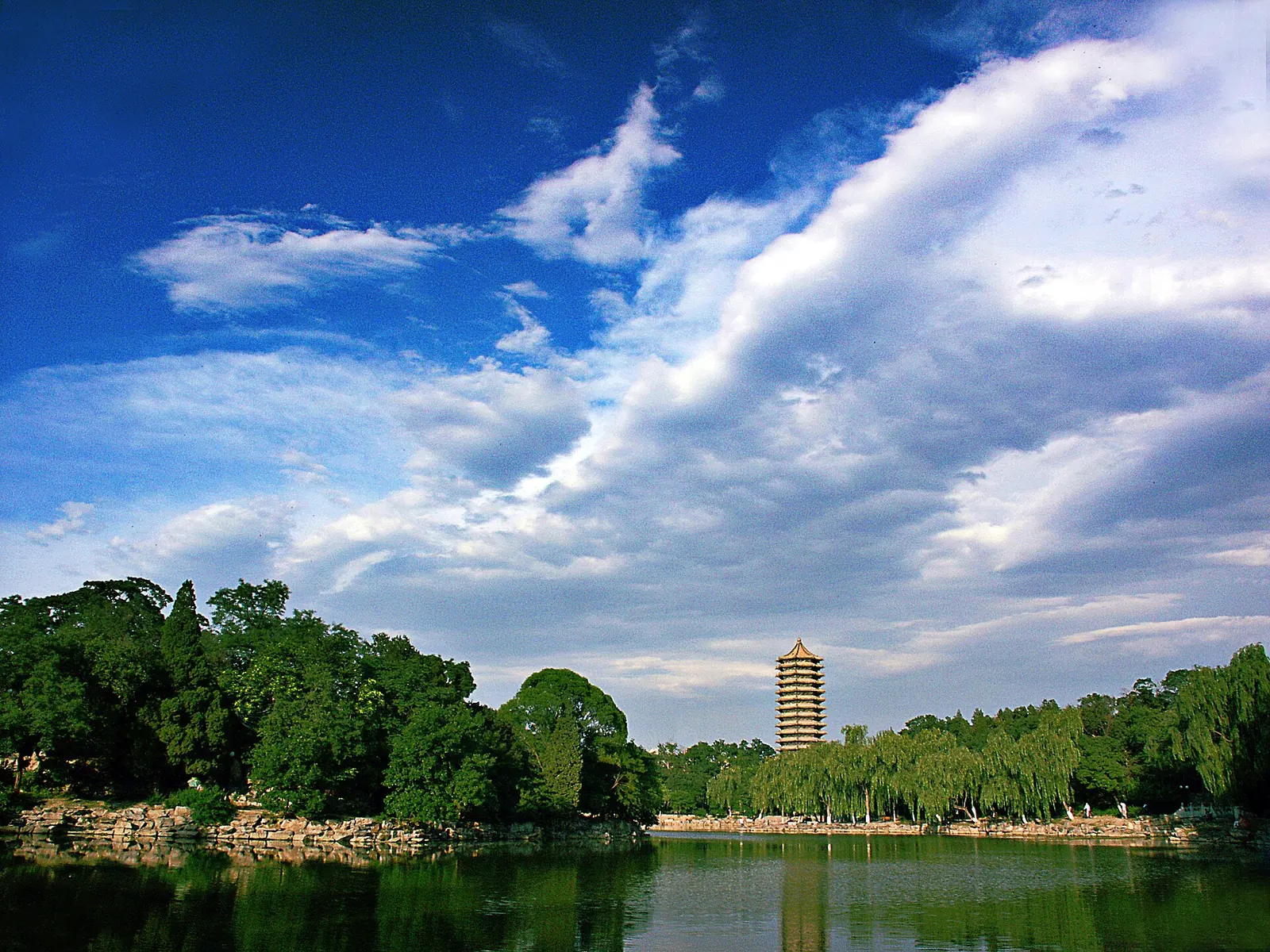
Peking University (北京大学) was founded in 1898 as the Imperial University of Peking — the first modern national university in China — and took its present name in 1912. It sits on the historic Yan Yuan gardens around Weiming Lake in the Haidian district of Beijing.
A member of the C9 League and the Double First-Class initiative, Peking University is known for its tradition of academic freedom and inclusiveness and for its strength across the humanities, social sciences, natural sciences, law, economics and medicine.
The university is organized into eight faculties with 55 schools and departments, more than 420 research institutions and six affiliated hospitals, and consistently ranks among the very top universities in China and Asia.
Consistently ranked the first or second university in the country
Top-ranked in China
Ranked #14 in the QS World University Rankings 2026 and consistently among the top universities in China.
C9 League member
Part of China’s elite C9 League and the national Double First-Class initiative.
Strong in humanities & sciences
Internationally recognized in the humanities, social sciences, law, economics, the natural sciences and medicine.
China’s first national university
Founded in 1898 as the Imperial University of Peking, with a long tradition of academic freedom and inclusiveness.
Admission
Admission, programs & tuition
Peking University admits international students to bachelor’s, master’s and doctoral degrees, as well as to non-degree programs. Applicants who first need to strengthen their Chinese and academic background can join the Yuke (Pre-University) Program. Applications are submitted through the online system at studyatpku.com, and tuition is set per academic year and varies by program.
Degree programs
Select a degree level to see tuition, duration and entry requirements.
Bachelor’s degreeUndergraduate
Four-year undergraduate degrees, taught mostly in Chinese with selected English-taught programs. Admission is by entrance examination or, for strong applicants, a no-written-examination track.
- Humanities & social sciences
- RMB 26,000 / year
- Science & engineering
- RMB 30,000 / year
- Other programs
- up to RMB 45,000 / year
Application requirements
- Foreign citizenship and a valid passport, meeting China’s Ministry of Education rules for international students.
- A high-school graduation certificate and academic transcripts.
- Chinese-taught programs: HSK Level 6 (210+ points) or qualifying HSK 7–9 scores.
- English-taught programs: TOEFL iBT 100+, IELTS 6.5+ or GRE 315+ for applicants whose first language is not English.
- Admission via the undergraduate entrance examination or the no-written-examination track for outstanding applicants.
- Personal statement and supporting documents submitted through the online application system.
Master’s degreeGraduate
Two- to three-year master’s degrees across the sciences, humanities, social sciences, management and medicine, taught in Chinese, English or bilingually.
- Standard programs
- RMB 29,000–50,000 / year
- Professional & business programs
- up to RMB 94,000 / year
Application requirements
- Foreign passport holder with a bachelor’s degree or equivalent.
- Academic transcripts and degree certificate.
- A study plan or research proposal.
- Two recommendation letters from professors.
- HSK or English-language test scores depending on the program’s language of instruction.
- Passport biographical page and program-specific materials.
Doctoral degreeGraduate
Doctoral study across the natural sciences, engineering, the humanities, social sciences and medicine.
- Doctoral programs
- RMB 32,000–62,000 / year
Application requirements
- Foreign passport holder with a master’s degree or equivalent.
- A detailed research plan and academic transcripts.
- Two academic recommendation letters from professors.
- Language-proficiency test scores as required by the program.
- Passport biographical page and program-specific materials.
Non-degree programs
Yuke (Pre-University) Program
A preparatory program that builds the Chinese-language and academic foundation international students need before entering undergraduate degree study at Peking University.
Fee · Published per intake
Chinese language programs
General and intensive Chinese-language study, including the PKU Chinese Language Summer School.
Fee · By program
Exchange & visiting students
Students nominated by partner universities study for one or two semesters; exchange students may be housed at the Zhongguanyuan Global Village.
Fee · Per exchange agreement
Documents to prepare
- Valid foreign passport (biographical page).
- Highest degree or graduation certificate, with authentication where required.
- Full academic transcripts.
- Language-proficiency scores — HSK for Chinese-taught programs, TOEFL/IELTS/GRE for English-taught programs.
- Personal statement, plus a study or research plan for graduate applicants.
- Recommendation letters (two, for graduate applicants).
- Physical-examination record and any program-specific documents.
Application timeline
These are the dates Peking University published for the 2026 intake. That cycle has closed. Use them as a guide to when each step falls in the year, and check the official pages for the 2027 dates before you plan around them.
- 1
Undergraduate application window
Jan–Feb 2026The online application system is open from 1 January to 28 February 2026.
- 2
Graduate applications
Autumn 2025 – Mar 2026Master’s and doctoral applications open in autumn 2025; the second examination round is held in March 2026.
- 3
Yuke (Pre-University) Program
By programThe Pre-University Program follows its own application notice and schedule.
- 4
Registration & start of the autumn semester
Aug–Sep 2026Admitted students register on campus and the academic year begins.
Tuition is charged per academic year and varies by school, program and language of instruction; professional and business master’s programs cost considerably more. Budget separately for the RMB 800 application fee, medical insurance and accommodation. Always confirm the current figure on the official program page before applying.
Funding
Scholarships
International students at Peking University can apply for government, municipal and university scholarships, most of which cover tuition fully or partly; the fully funded options also include accommodation, a living stipend and insurance.
Chinese Government Scholarship (Type A & Type B)
Full or partial funding — tuition, accommodation, a living stipend and medical insurance, depending on the type.
Eligibility: Non-Chinese citizens applying for degree study, applied for through the CSC channel together with Peking University.
Beijing Government Scholarship
Full or partial tuition for one academic year.
Eligibility: International degree students at Beijing universities, awarded on academic merit.
PKU Scholarship for International Students
Full or partial tuition, awarded on academic performance.
Eligibility: Self-funded international degree students.
Yenching Academy Scholarship
Full funding for the master’s in China Studies — tuition, accommodation, a travel stipend, health insurance and a living allowance.
Eligibility: Outstanding international and Chinese students admitted to the Yenching Academy.
Center for Language Education & Cooperation scholarships
Tuition, accommodation and stipend for Chinese-language study and the China Studies Program.
Eligibility: Students of Chinese language and the International Chinese Language Teachers track.
Research
Research at the university
Peking University is one of China’s foremost research universities, running more than 420 research institutions — including a national laboratory, state key laboratories and national engineering research centers — across the sciences, humanities, social sciences and medicine.
National & state key laboratories
A national laboratory, seven state key laboratories and five national engineering research centers, including the Beijing National Laboratory for Molecular Sciences.
Natural sciences
Strengths in physics, chemistry, mathematics, life sciences and materials — from turbulence and complex systems to rare-earth materials chemistry.
Humanities & social sciences
China’s leading center for the humanities, law, economics, sociology, philosophy and Chinese studies.
Medicine
The PKU Health Science Center and six affiliated hospitals drive medical research and clinical training.
- PKU alumna Tu Youyou won the 2015 Nobel Prize in Physiology or Medicine for discovering artemisinin.
- The university runs more than 420 research institutions across every major discipline.
- PKU operates joint research centers with leading global universities, including the Stanford Center at Peking University.
- PKU and Tsinghua jointly host national key laboratories such as the Key Laboratory of Membrane Biology.
Global engagement
Global engagement
Peking University maintains one of China’s largest international networks, with partnerships for exchange, joint research and joint and dual degrees across the world.
Yenching Academy
An interdisciplinary, fully funded master’s in China Studies that brings together outstanding international and Chinese students.
PKU–Waseda dual degrees
A partnership since 1982 with dual bachelor’s, joint master’s and dual doctoral degrees — undergraduates spend their third year at Waseda University in Japan.
Joint degrees with leading universities
Joint and dual degree programs with the London School of Economics, Sciences Po, the University of Tokyo and Seoul National University.
Stanford Center at Peking University
A joint research and teaching center on the PKU campus, part of a long collaboration with Stanford University.
Career
Career & alumni
Peking University graduates are highly sought after in China and abroad — PKU ranks among the world’s top universities for graduate employability.
Career support
- A university career center offering counselling, workshops and employability support.
- Recruitment fairs and employer-connection events with leading Chinese and international employers.
- Guidance on graduate study, public service and international-organization careers.
- Ranked among the world’s top 25 universities for graduate employability in the QS World University Rankings.
Notable alumni
Tu Youyou
Nobel Prize-winning scientist (Physiology or Medicine, 2015); discovered artemisinin.
Li Keqiang
Former Premier of China; studied law and economics at Peking University.
Robin Li (Li Yanhong)
Co-founder and CEO of Baidu; studied information management at PKU.
Wang Xuan
Computer scientist and pioneer of Chinese-language laser typesetting.
Campus life
Campus life
Peking University’s campus is built around Weiming Lake and the classical Yan Yuan gardens, and is considered one of the most beautiful and historic in China.
Accommodation
Zhongguanyuan Global Village
RMB 180–220 per person per day, by room type
A complex outside the south-east gate of campus combining accommodation, dining and conference facilities; rooms are limited and booked in advance.
Dining
Peking University has more than ten dining halls and cafeterias across campus serving Chinese and international food at student prices.
Facilities
Libraries
One of the largest academic libraries in Asia, with extensive Chinese and foreign-language collections.
Sport & recreation
Gymnasiums, swimming pools, basketball courts and yoga studios; the main gymnasium is near the south-east gate.
Health care
On-campus medical services and affiliated hospitals; medical insurance is required for international students.
Student life
A historic campus around Weiming Lake with many student associations, clubs and cultural activities.
FAQ
Frequently asked questions
How much is tuition at Peking University for international students?+
Undergraduate tuition runs from RMB 26,000 to RMB 45,000 per year. Master’s programs cost roughly RMB 29,000–94,000 per year and doctoral programs RMB 32,000–62,000 per year, depending on the program.
What are the admission requirements for international students at Peking University?+
Applicants must be non-Chinese citizens with a valid passport. Chinese-taught programs require HSK Level 6 (210+ points); English-taught programs require TOEFL iBT 100, IELTS 6.5 or GRE 315. Undergraduate applicants also need a high-school diploma and transcripts; graduate applicants need the relevant prior degree, recommendation letters and a study or research plan.
Does Peking University offer scholarships for international students?+
Yes. International students can apply for the Chinese Government Scholarship, the Beijing Government Scholarship, the PKU Scholarship for International Students, the fully funded Yenching Academy scholarship and Chinese-language scholarships.
When is the application deadline for Peking University?+
Undergraduate applications for 2026 are open from 1 January to 28 February 2026. Graduate (master’s and doctoral) applications open in autumn 2025, with a second examination round in March 2026.
Does Peking University have a foundation or pre-university program?+
Yes. The Yuke (Pre-University) Program prepares international students in Chinese language and academic skills before they enter undergraduate degree study.
Where do international students live at Peking University?+
International students can apply for rooms at the Zhongguanyuan Global Village, a residence complex outside the south-east gate of campus, at roughly RMB 180–220 per person per day.
Contact
Contact the admissions offices
Reach the International Students Division, Office of International Relations for questions about applications, documents, scholarships and arrival. Type university programs and offices are based on campus in Beijing.
- Office
- International Students Division, Office of International Relations
- Address
- International Students Division, New Sun Student Center, Peking University, Beijing 100871, P.R. China
Verified from official sources · last checked 2026-05-17
Tuition, fees and deadlines change every intake. Always confirm the current figures on the official Peking University pages before applying.