
About
About Shenzhen University
Shenzhen University (深圳大学, SZU) was established in 1983 — Wikipedia gives the date as 27 September 1983 — to serve the Shenzhen Special Economic Zone, the first of China’s special economic zones. SZU’s About page credits Peking, Tsinghua and Renmin universities with support in founding its first schools and describes it as "distinctively known as an Experimental University in higher education". Wikipedia describes it as a municipal public research university funded by the Shenzhen government.
SZU teaches on two campuses, both in Nanshan District: Yuehai Campus at 3688 Nanhai Avenue, home to the College of International Exchange (CIE) and, on the 2026 program lists, to all undergraduate liberal-arts and arts majors and most master’s programs, and Lihu Campus on Xueyuan Avenue, where the 2026 undergraduate list places every science and engineering major. Your campus decides your dormitory options and rent.
The university’s Statistics page (undated) counts 48,589 students, 4,473 faculty and staff, 28 colleges, 105 undergraduate majors, 27 doctoral and 73 master’s disciplines, 14 post-doctoral stations, 20 disciplines in the ESI top 1% and three affiliated hospitals. Official figures for international students disagree: the same Statistics page gives 820, while the CIE’s own introduction states that "In 2025, SZU has 1288 international students in total, of which about 72% are degree students, and more than 25% of the degree students are PhD students." SZU has enrolled international students since 1987 and says it has trained nearly 20,000 of them from more than 100 countries.
The QS page also shows =416 in the QS World University Rankings 2027
The same ShanghaiRanking page places SZU #66 in the 2026 Best Chinese Universities Ranking
SZU Statistics page
Built with the Special Economic Zone
Founded in 1983 to serve China’s first Special Economic Zone, now a comprehensive university in a key city of the Guangdong-Hong Kong-Macau Greater Bay Area.
An entrepreneurial alumni base
SZU’s About page states that "alumni including Tencent have founded dozens of innovative companies with significant influence"; Tencent founder Ma Huateng is an SZU alumnus.
English-taught doctorates
Only two programs on the September 2026 doctoral list are taught in Chinese; the rest, from computer science to law and basic medicine, are in English.
Fees set by discipline, not by language
Three tuition bands per level — liberal arts; science and engineering; medicine, arts and physical education — with no separate rate for English-taught programs.
Admission
Admission, programs & tuition
Shenzhen University admits international students to bachelor’s, master’s and doctoral degrees and to a long-term Chinese language program, all through the College of International Exchange (CIE) and its online system at status.szu.edu.cn. The 2026 brochures, published on 25 December 2025, open applications on 1 January 2026 for the September 2026 intake: undergraduates apply in one of two rounds (to 20 March, or 20 March to 31 May), while master’s and doctoral applications close on 31 May 2026. Doctoral study also has a March intake. Age limits are set per level — 18–25 for bachelor’s, under 35 for master’s, under 40 for doctoral study — and the HSK level depends on discipline rather than on degree. None of the 2026 brochures mentions the China Scholastic Competency Assessment (CSCA); they say only that remote or face-to-face interviews may be arranged if necessary. Master’s and doctoral applicants must first secure a letter of recommendation from a potential supervisor.
Degree programs
Select a degree level to see tuition, duration and entry requirements.
Bachelor’s degreeUndergraduate
Four-year degrees, mostly taught in Chinese. Three 2026 majors are taught in English: International Business Administration, International Economics and Trade, and Financial Technology (WeBank ASEAN Class). The Chinese-taught list covers liberal arts and arts on Yuehai Campus (Chinese Language and Literature, TCSOL, law, psychology, management, media, fine arts, design, music) and science and engineering on Lihu Campus (electronic information, computer science, civil engineering, materials, chemistry, environmental engineering). The 2026 list has no medicine majors, although the fee table has a medicine band.
- Liberal arts
- RMB 26,000 / year
- Science & engineering
- RMB 30,000 / year
- Medicine, arts, physical education
- RMB 40,000 / year
Application requirements
- Non-Chinese citizen with a valid foreign passport, aged 18 to 25.
- High-school diploma or above; students still at school may apply with a pre-graduation certificate showing the expected graduation date and must present the original diploma, transcripts and translations at registration.
- Ministry of Education Document No. 12 (2020): a foreign passport held for four years or more, and at least two years of actual residence abroad in the last four (nine months abroad in a year counts as one year, judged by passport stamps) — this also applies to applicants who emigrated from mainland China, Hong Kong, Macao or Taiwan.
- Chinese-taught science and engineering majors: HSK 4 with at least 180 points. Chinese-taught liberal arts, medicine and arts majors: HSK 5 with at least 180 points. No HSK is required for Chinese Language and Literature or for Teaching Chinese to Speakers of Other Languages.
- English-taught majors: IELTS 5.5, TOEFL iBT 80 or Duolingo 100 or above.
- Arts majors in the Division of Arts require a specialized test.
- Remote or face-to-face interviews may be arranged if necessary; the 2026 brochure does not mention the CSCA.
Master’s degreeGraduate
Two- to three-year degrees, depending on the program. The 2026 list is mostly Chinese-taught — International Chinese Language Education, journalism, psychology, art and design, control engineering, computer technology, architecture, materials, environmental engineering, law and public administration among them. Three programs are taught in English: Foreign Languages and Literature, Area Studies, and Civil Engineering.
- Liberal arts
- RMB 30,000 / year
- Science & engineering
- RMB 35,000 / year
- Medicine, arts, physical education
- RMB 45,000 / year
Application requirements
- Non-Chinese citizen with a valid foreign passport, under the age of 35, holding a bachelor’s degree or above (recent graduates may submit a pre-graduation certificate).
- Chinese-taught programs: HSK 4 with at least 180 points for science and engineering; HSK 5 with at least 180 points for liberal arts, medicine and arts.
- English-taught programs: applicants whose native language is not English must provide proof of English proficiency. Unlike the undergraduate brochure, the master’s brochure sets no minimum IELTS, TOEFL or Duolingo score; native speakers of Chinese or English may be exempted once the university recognises it.
- First step of the procedure: contact a potential supervisor and ask for a letter of recommendation.
- Two recommendation letters signed by professors or associate professors, and a personal statement of around 800 words in English or Chinese.
Doctoral degreeGraduate
Three- to four-year doctorates (five years at most). The September 2026 list is overwhelmingly English-taught — only Education and Materials Science and Engineering are in Chinese — spanning engineering, computer science, optics, physics, chemistry, biology, basic medicine, biomedical engineering, economics, management, journalism and law, plus professional doctorates in integrated circuit and optoelectronic information engineering. A March intake also exists: its 2026 round took applications from 10 October to 30 November 2025, at the same tuition.
- Liberal arts
- RMB 34,000 / year
- Science & engineering
- RMB 40,000 / year
- Medicine, arts, physical education
- RMB 52,000 / year
Application requirements
- Non-Chinese citizen with a valid foreign passport, under the age of 40, holding a master’s degree or above.
- Chinese-taught programs: HSK 4 with at least 180 points for science and engineering; HSK 5 with at least 180 points for liberal arts, medicine and arts.
- English-taught programs: an English proficiency certificate — the brochure sets no minimum score; native speakers of Chinese or English can be exempted.
- A Letter of Recommendation from the potential supervisor, obtained before applying.
- Two recommendation letters from professors or associate professors, with the referee’s name and contact details, and a self-statement of around 1,500 words covering the intended program and supervisor, study and work experience and research results.
- Remote or face-to-face interviews may be arranged during expert review if necessary.
Non-degree programs
Long-term Chinese Language Program (offline)
Run by the CIE, with 24 or more class hours a week in eight levels from Beginner A to Advanced and a Business class. Applicants must be 18 to 60 and hold a foreign passport valid for more than six months. One-semester students enter on a single-entry X2 study visa; one-year students enter on an X1 visa and must obtain a residence permit within 30 days. The autumn 2026 application window was 15 May – 25 June 2026 (marked as estimated). Two points to plan around: the program provides no on-campus accommodation, and tuition is not refunded once the residence permit has been issued.
Fee · RMB 11,000 / semester (RMB 22,000 for two semesters), plus RMB 400 application fee
Visiting students from partner universities
SZU’s English site invites undergraduate students of its partner universities to join visiting programs across the humanities, foreign languages, media, arts, economics, management, law and the science and engineering colleges, and tells them to "apply with student exchange coordinator at your home university." The page dates from 2022 and gives no duration, fee or deadline; non-degree students arrange their own housing.
Fee · Not published
Documents to prepare
- Highest diploma and transcripts (high school for bachelor’s, bachelor’s for master’s, master’s for doctoral); recent graduates may upload a pre-graduation certificate and show originals at registration.
- Photo of the passport information page and a passport-style photograph.
- Language certificate — HSK for Chinese-taught programs, English proficiency for English-taught ones.
- Foreigner Physical Examination Form.
- Personal resume.
- Two recommendation letters — from school or teachers (bachelor’s) or from professors or associate professors (master’s and doctoral).
- Study plan or statement: about 500 words (bachelor’s), 800 words (master’s) or 1,500 words (doctoral).
- Master’s and doctoral applicants: a letter of recommendation from the potential supervisor.
- Guangdong Government Scholarship applicants: the completed scholarship form.
- Payment voucher for the application fee.
Application timeline
These are the dates Shenzhen University published for the 2026 intake. That cycle has closed. Use them as a guide to when each step falls in the year, and check the official pages for the 2027 dates before you plan around them.
- 1
March 2026 doctoral intake applications
10 Oct – 30 Nov 2025Pre-admission results followed in December 2025 and admission materials in January 2026.
- 2
Applications open for September 2026
1 Jan 2026All degree levels, at status.szu.edu.cn.
- 3
End of the first undergraduate round
20 Mar 2026First-round pre-admission results are emailed in April.
- 4
Shenzhen Universiade Scholarship applications
17 – 30 Apr 2026For students already enrolled at SZU; first-year undergraduates are excluded.
- 5
Autumn Chinese language program applications
15 May – 25 Jun 2026The CIE marks this window as estimated.
- 6
Application deadline for degree programs
31 May 2026Second undergraduate round, master’s and doctoral.
- 7
Pre-admission results
Jun 2026Sent by email for the second undergraduate round and for master’s and doctoral applicants.
- 8
Guangdong Government Scholarship — continuing students
6 Jul – 14 Aug 2026Results in October 2026.
- 9
Final admission
Jul 2026Scanned admission materials are emailed to admitted applicants.
- 10
Registration and start of the semester
Sep 2026On the date in the Admission Notice; the X1 visa must be converted to a residence permit within 30 days of entry.
- 11
Guangdong Government Scholarship — new students
3 – 5 Sep 2026In person at CIE Room 320; winners are announced in late October 2026 and paid by the end of 2026.
Tuition is set by discipline group (liberal arts; science and engineering; medicine, arts and physical education), not by language. The CIE’s Tuition page adds: insurance at RMB 400 per semester or RMB 800 per year, textbooks at about RMB 300 per semester, a physical examination at about RMB 700 per year, a residence permit at RMB 800 (12 months or more) or RMB 400 (under 12 months), and RMB 30 for a campus card. Accommodation runs from RMB 750 to RMB 10,000 per semester. Confirm figures with the CIE before paying.
Funding
Scholarships
SZU’s 2026 brochures list a provincial award (Guangdong Government), a municipal award (Shenzhen Universiade) and the university’s own Liyuan International Scholarship, plus the International Chinese Language Teachers Scholarship, applied for separately. Neither the brochures nor the CIE scholarship pages list a Chinese Government Scholarship (CSC) channel. The brochures give no application procedure or number of places for the Liyuan award — ask the CIE when you apply. Timing matters: new students apply for the Guangdong award after arrival (3–5 September 2026), the Shenzhen Universiade Scholarship is only for students already enrolled, and the university’s academic and incentive awards are decided each December.
Guangdong Government Outstanding International Student Scholarship (广东省政府来粤留学生奖学金)
A cash award of RMB 10,000 a year for undergraduates, RMB 20,000 for master’s students and RMB 30,000 for doctoral students. The 2026 guides offer 24/6/20 places (bachelor’s/master’s/doctoral) for new students and 20/8/24 for continuing students, paid into a Bank of China account by the end of 2026.
Eligibility: New students: degree students enrolled in spring or autumn 2026, under 30 (bachelor’s), 35 (master’s) or 40 (doctoral), holding no Chinese government, Confucius Institute or other Chinese government funding. Apply in person at CIE Room 320 on 3–5 September 2026 with degree certificates, transcripts, HSK 4 or above (Chinese-taught programs only), passport copy, an 800-character statement and two recommendation letters; results in late October 2026. Continuing students: at least one year at SZU, under 40, all compulsory courses at B or above, and a 2025–2026 GPA of at least 3.0 (undergraduates) or 2.6 (postgraduates); applications ran 6 July – 14 August 2026.
Shenzhen Universiade Scholarship (深圳大运奖学金)
The brochures list RMB 30,000 a year for undergraduates, RMB 35,000 for master’s students and RMB 40,000 for doctoral students; the 2026 notice confirms those amounts, sets 52 places for degree students in total, and also offers RMB 10,000 a year to students learning Chinese in Shenzhen (15 places).
Eligibility: Although the undergraduate brochure lists it, the 2026 notice (17 April 2026) limits it to students already enrolled full-time at SZU and excludes first-year undergraduates, degree students outside China in 2026–2027, students with deferred graduation and previous recipients. Undergraduates need a GPA of at least 3.5 in each of the last two semesters and master’s students 3.0, with no failed compulsory courses; doctoral students need papers published as first or second author. Applications ran 17–30 April 2026 on apply.suisf.org.cn, with a video of up to five minutes, two recommendation letters and transcripts.
Liyuan International Scholarship (荔园国际奖学金) — Shenzhen University
Bachelor’s and master’s: first class, tuition waiver plus a living allowance of RMB 1,000 a month; second class, tuition waiver; third class, 50% of tuition waived. Doctoral: first class, tuition waiver plus RMB 6,000 a month; second class, tuition waiver plus RMB 5,000 a month; third class, tuition waiver plus RMB 4,000 a month. Doctoral supervisors also provide their international doctoral students with an allowance of at least RMB 12,000 a year for research or academic exchange. If a doctorate is extended, the brochure grants the university’s basic support for the first extra year only.
Eligibility: Listed for new bachelor’s, master’s and doctoral students, with no separate procedure or quota published. Holders are reviewed each year on conduct, results, research and activities: in the January 2026 review, first-class undergraduates below a 3.5 GPA and first-class master’s students below 3.0 dropped to second class, and the award was withdrawn for disciplinary sanctions, failed courses, transfer, suspension or withdrawal.
Shenzhen University International Student Academic Scholarship (学业奖学金)
Undergraduates: RMB 10,000 (first prize), RMB 7,000 (second) or RMB 4,000 (third). Master’s students: RMB 15,000, RMB 10,000 or RMB 5,000.
Eligibility: Enrolled undergraduate and master’s students with no failed compulsory courses in the previous academic year and a GPA of at least 2.5 (undergraduates) or 2.0 (master’s), who have no legal or disciplinary violations and did not receive that year’s Guangdong or Shenzhen Universiade scholarship. It is decided each December; the 2025 round took applications on 4–5 and 8–10 December 2025.
Social Practice and Chinese Language Proficiency (HSK) Incentive Awards
Social practice: RMB 500 to 8,000. HSK (180 points or more): RMB 800–1,500 for HSK 3–6 in non-Chinese-taught majors; RMB 1,000 for HSK 6 in Chinese-taught majors.
Eligibility: Enrolled degree and language students with a clean disciplinary record — active participants in group activities (social practice) or those who passed the HSK well while at SZU. The 2025 round was applied for in December 2025.
International Chinese Language Teachers Scholarship
Set by the program; not restated by SZU.
Eligibility: Apply on cis.chinese.cn before the designated date, as the 2026 brochures instruct.
Research
Research at the university
SZU’s English research pages list its key institutes and laboratories but publish no research funding or output totals beyond the Statistics page figures. The laboratory list points to its strengths — radio-frequency and integrated-circuit technology, optoelectronics, big-data computing, biomedicine and coastal civil engineering — and the English-taught doctoral list follows the same lines.
Radio-frequency & integrated circuits
The State Key Laboratory of Radio Frequency Heterogeneous Integration, plus an English-taught professional doctorate in integrated circuit engineering.
Optoelectronics & optical engineering
The Key Laboratory of Optoelectronic Devices and Systems of the Ministry of Education and Guangdong Province; two units offer optical engineering doctorates.
Big data & intelligent information
The National Engineering Laboratory of Big Data System Computing Technology and the Guangdong Key Laboratory of Intelligent Information Processing.
Biomedicine & life sciences
The Research Center for National Biochemical Engineering Technology, and Guangdong key laboratories for biomedical information detection and ultrasound imaging, plant epigenetics, and genome stability and disease control.
Coastal civil engineering
The Key Laboratory of Coastal Civil Engineering Durability of Guangdong Province; civil engineering is taught in English at master’s and doctoral level.
- 5,679 authorized patents (SZU Statistics page).
- 984 online courses joined by 139 universities, taken by nearly 3,470,000 students (SZU Statistics page).
- Ranked 151–200 in the 2026 Academic Ranking of World Universities (ShanghaiRanking).
Global engagement
Global engagement
SZU says it is "accelerating its pace toward internationalization" through partnerships with overseas institutions offering exchange programs, joint degrees and research collaborations, and its Statistics page counts 321 global partner universities. It does not publish an English list of named partners or joint-degree programs.
Visiting programs for partner-university students
Undergraduates of partner universities can join visiting programs across most colleges, applying through their home university’s exchange coordinator.
WeBank ASEAN Class
An English-taught Financial Technology bachelor’s class at the WeBank Institute of Financial Technology.
"Guangdong Products Going Global" training camp
The third edition of this four-week global youth cross-border e-commerce and digital marketing camp opened in November 2025, co-organized by the CIE, with nearly 100 students from SZU, Harbin Institute of Technology (Shenzhen), Ohio State University and elsewhere.
Career
Career & alumni
SZU’s English Career page carries faculty and postdoctoral recruitment notices rather than student career services, and the university publishes no employment or salary statistics for international graduates — treat any such figure you see elsewhere as unsourced. For international students, the CIE’s news shows the support on offer: in May 2025 it took more than 40 international students from over 10 countries to the third international talent job fair at Shenzhen University Town, where several received interview invitations on the spot.
Career support
- CIE-organized visits to international talent job fairs — at the May 2025 fair, more than 50 employers from technology, finance, education and trade took part.
- Enterprise visits for international students — in December 2025, members of SZU’s Red Culture International Mission and of the "Guangdong Products Going Global" program visited companies together.
- The "Guangdong Products Going Global" cross-border e-commerce training camp — four weeks of classes and live projects.
Notable alumni
Ma Huateng
Entrepreneur and founder of Tencent.
Campus life
Campus life
Whether you get a room depends on your program: degree students can live on campus, but the CIE’s accommodation guide for non-degree students states that "the university does not provide housing" for them — Chinese language students rent off campus, and the CIE only recommends rental platforms (Lianjia, BEKE, Boyu Apartment) without taking part in any transaction. The 2026 brochures quote RMB 2,400–8,000 per student per semester for single and double rooms on Yuehai Campus and RMB 750 for a four-bed room on Lihu Campus. Rooms are for students only (no relatives or friends), water and electricity are charged by use, and students bring their own bedding. The campus card serves as ID and pays for school buses, canteens, the library and sports facilities.
Accommodation
International Students’ Dormitory — Yuehai Campus
Single RMB 8,000, double RMB 6,000, suite RMB 10,000 per student per semester
Air conditioning, en-suite bathroom, desk and wardrobe. The suite price (on the Tuition page and an undated fee list) is above the RMB 2,400–8,000 range in the 2026 brochures — confirm before booking. The undated fee list adds a reservation and management fee of one month’s rent (RMB 1,667 suite, 1,333 single, 1,000 double).
Lingxiaozhai (Lingxiao Building) — Yuehai Campus
RMB 2,400 per student per semester
The cheapest Yuehai option, with air conditioning and en-suite bathroom; the undated fee list adds a RMB 400 reservation and management fee.
Haixing, Haiwan and Haiqing buildings — Yuehai Campus
Single RMB 6,600, double RMB 5,400 per student per semester
Listed only in the undated fee list attached on the CIE site (reservation and management fee RMB 1,100 single, RMB 900 double); not mentioned in the 2026 brochures.
Lihu Campus dormitory
RMB 750 per student per semester
As quoted in all three 2026 degree brochures.
Non-degree students (Chinese language program)
Market rent — not published
The autumn 2026 Chinese language program notice states that the course provides no on-campus accommodation.
Dining
SZU counts 12 canteens. The New Southwest and Old Southwest canteens are within a five-minute walk of the international student dormitory, and the New Southwest Canteen serves halal food on its 4th floor; the Housing & Dining page also lists the South District Canteen (food court on the 3rd floor), the Zhai District Canteen and a Starbucks in Alumni Plaza. Meals are paid by campus card; SZU does not publish meal prices.
Facilities
Sports
Yuanping Stadium and Gymnasium, a golf course, a bowling alley, a table tennis hall, pools, basketball and tennis courts, and a seaside football field; the campus card carries a RMB 150 per semester sports subsidy.
Library
4,753,600 books and 4,248,500 e-journals, according to the Statistics page.
International student life
The CIE runs a Language Learning Center and lists an International Choir and a Dance Society among its student clubs; the eighth International Cultural Festival took place in May 2025.
Insurance, health check and permits
International students must buy the SZU-designated group all-risk insurance (RMB 400 per semester). Degree students enter on an X1 visa and convert it to a residence permit within 30 days.
Two campuses in Nanshan
Yuehai and Lihu, both in Nanshan District, with 41 dormitory buildings between them.
Campus
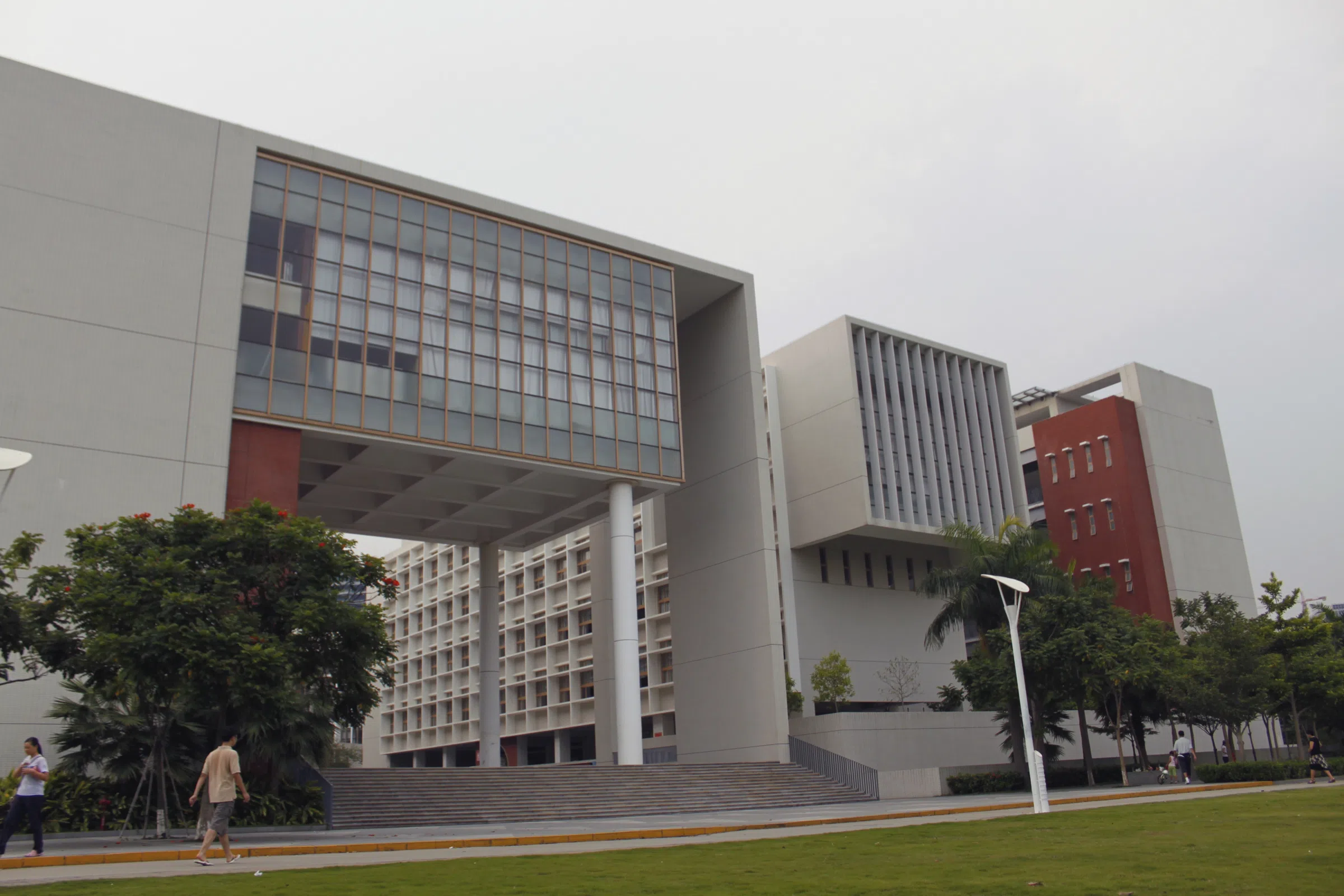
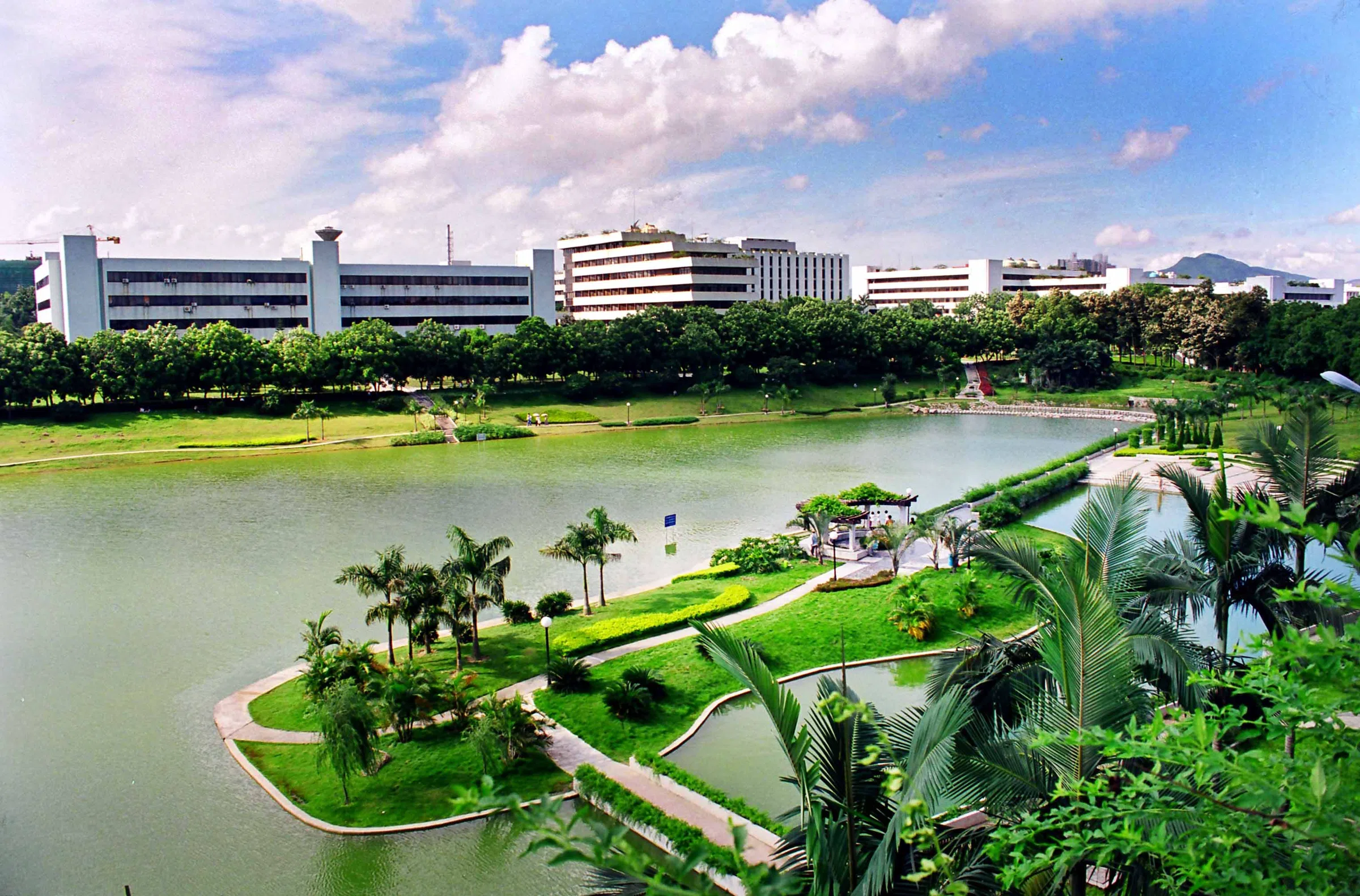
Shenzhen University in photos
FAQ
Frequently asked questions
How much is tuition at Shenzhen University for international students?+
It depends on level and discipline group, not on language. Bachelor’s: RMB 26,000 a year (liberal arts), RMB 30,000 (science and engineering) or RMB 40,000 (medicine, arts, physical education). Master’s: RMB 30,000, 35,000 or 45,000. Doctoral: RMB 34,000, 40,000 or 52,000. The Chinese language program is RMB 11,000 a semester. Add the RMB 400 non-refundable application fee, insurance (RMB 400 per semester), textbooks, the physical examination, the residence permit and accommodation.
What are the language requirements?+
Chinese-taught programs at every level ask for HSK 4 with at least 180 points in science and engineering and HSK 5 with at least 180 points in liberal arts, medicine and arts; undergraduate Chinese Language and Literature and TCSOL need no HSK. English-taught bachelor’s majors ask for IELTS 5.5, TOEFL iBT 80 or Duolingo 100. The master’s and doctoral brochures ask only for proof of English proficiency, with no minimum score — confirm what is accepted with the CIE or your supervisor.
When is the application deadline for September 2026?+
For September 2026, applications opened on 1 January 2026. Undergraduates applied in the first round (to 20 March, results in April) or the second (20 March – 31 May, results in June); master’s and doctoral applications closed on 31 May, with results in June and final admission in July. The autumn Chinese language program took applications from 15 May to 25 June 2026 (estimated). The March 2026 doctoral intake ran from 10 October to 30 November 2025. SZU had not published a 2027 brochure as of this update.
Does Shenzhen University offer scholarships to international students?+
Yes: the Guangdong Government Scholarship (RMB 10,000 / 20,000 / 30,000 a year for bachelor’s, master’s and doctoral students), the Shenzhen Universiade Scholarship (RMB 30,000 / 35,000 / 40,000) and SZU’s Liyuan International Scholarship — from a 50% tuition reduction to a full waiver plus RMB 1,000 a month for bachelor’s and master’s students, and a waiver plus RMB 4,000–6,000 a month for doctoral students. New students apply for the Guangdong award after arriving (3–5 September 2026); the Universiade award is only for enrolled students, not first-year undergraduates. SZU’s pages list no CSC channel.
Is there an age limit?+
Yes: bachelor’s applicants must be 18 to 25, master’s applicants under 35 and doctoral applicants under 40; the Chinese language program takes applicants aged 18 to 60. The Guangdong scholarship for new students has its own caps (under 30 for undergraduates), but the admission limit still applies.
Which programs are taught in English?+
Bachelor’s: International Business Administration, International Economics and Trade, and Financial Technology (WeBank ASEAN Class). Master’s: Foreign Languages and Literature, Area Studies, and Civil Engineering. Doctoral: almost everything — only Education and Materials Science and Engineering are Chinese-taught on the September 2026 list. English-taught programs cost the same as Chinese-taught ones in the same discipline group.
Where do international students live, and what does it cost?+
Degree students can live on campus: on Yuehai Campus, RMB 8,000 per semester for a single or RMB 6,000 for a double in the International Students’ Dormitory, or RMB 2,400 for a Lingxiaozhai double; on Lihu Campus, RMB 750 for a four-bed room. Water and electricity are extra. Chinese language and other non-degree students get no university housing and must rent off campus.
Contact
Contact the admissions offices
Reach the College of International Exchange (CIE), Shenzhen University — Admissions Office, Room 301 for questions about applications, documents, scholarships and arrival. Type university programs and offices are based on campus in Shenzhen.
- Office
- College of International Exchange (CIE), Shenzhen University — Admissions Office, Room 301
- Address
- 3rd Floor, Zonghe Building (综合楼), Shenzhen University, 3688 Nanhai Avenue, Nanshan District, Shenzhen, Guangdong 518060, China (the 2026 brochures give it as "301 3/F, Zhaoxi building")
- szulxs@szu.edu.cn — degree student admissions (bachelor’s, master’s, doctoral)ciec@szu.edu.cn — Chinese language (non-degree) studentsciestudents@szu.edu.cn — Guangdong Government Scholarship applications and Liyuan scholarship reviewsinternational@szu.edu.cn — International Office (visits and cooperation, not admissions)
- Phone
- +86-755-26558894 — degree student admissions (also listed for the Admissions Office, Room 301)+86-755-26535159 — Admissions Office, Room 301 (enquiries, registration, JW202 form)+86-755-86937695 — Chinese language (non-degree) students+86-755-26538280 — Language Programs office, Room 304+86-755-26557139 — College Administration Office, Room 305 (fee payment, student cards, scholarships)+86-755-86678400 — Guangdong Government Scholarship enquiries (Ms Zhang, Room 320)+86-755-26536114 — Shenzhen University switchboard
Verified from official sources · last checked 2026-09-15
Tuition, fees and deadlines change every intake. Always confirm the current figures on the official Shenzhen University pages before applying.
- 2026 Bachelor Program admission brochure (CIE)
- 2026 Bachelor Program admission brochure (university site)
- 2026 undergraduate programs for international students
- 2026 Master Program admission brochure (CIE)
- 2026 Master Program admission brochure (university site)
- 2026 master’s programs for international students
- Doctoral Program admission brochure, September 2026 intake (CIE)
- Doctoral programs, September 2026 intake
- Doctoral Program admission brochure, March 2026 intake
- Autumn 2026 long-term Chinese language program
- CIE brochure directory
- CIE tuition and fees
- CIE scholarship notices
- 2026 Guangdong Government Scholarship guide — new students
- 2026 Guangdong Government Scholarship guide — continuing students
- 2026 Shenzhen Universiade Scholarship notice
- Liyuan International Scholarship review notice (January 2026)
- 2025 SZU International Student Academic Scholarship notice
- 2025 social practice and HSK incentive awards notice
- International student dormitory price list
- International student dormitory fee list (attachment 3)
- Accommodation guide for non-degree students
- Introducing the CIE
- CIE contact page
- CIE international student life
- International talent job fair (May 2025)
- "Guangdong Products Going Global" training camp (November 2025)
- About SZU
- SZU statistics
- Key institutes and labs
- Visiting student programs
- Housing and dining
- Sports facilities
- SZU career page
- Contact SZU
- QS World University Rankings — Shenzhen University
- THE World University Rankings — Shenzhen University
- ShanghaiRanking — Shenzhen University
- Wikipedia — Shenzhen University